Grey Matters
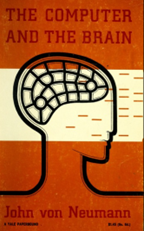
The following is a comparison between The Computer and The Brain (title stolen from Von Neumann's manuscript, below).
The Computer
Arguably, circa 1940 was the beginning of the modern computing era. The way was paved by the works of Turing, von Neumann, and many others. Computers in the pre-2000's were dominated by the von Neumann architecture, where logic and memory are separated. This was good enough for black-and-white problems such as math and business rules, but it falls short in the grey areas where fuzzy concepts are difficult quantify and write code for.
 50 Shades of Green (is it a bush, or a tree?). Conventional software fails at these problems.
Enter circa 2000, where neural networks (main stream AI) blur the lines between hardware and software, and the von Neumann separation of logic hardware from memory fades away. Neural networks are better at fuzzy problems in the grey area. Today, AI still runs on software and hardware, but such systems are ultimately simulating neural networks without that separation.
We propose using neural tissue for computing -- not hardware, not software, but "wetware". In one sense, wetware is still in the gestational "transistor-building" stage -- but instead of building transistors we are growing neurons. In another sense, wetware has reached adulthood, achieving consciousness and intelligence hundreds of thousands of years before the modern GPU, and for by orders of magnitude less power use over today's GPU farms.
The Brain
 The bee brain is about the size of a sesame seed.
The advantage of merging logic and memory can be seen in something as superficially "primitive" as a bee. A bee has about 1 million neuron packed in a 1 mm3 sized granule and consumes less energy than an a single christmas tree light bulb. Yet bees are capable of forming a societies to build megastructures (the hive), capable of body language communication, and capable of flight & navigation 1-mile away from the hive. We can draw inspiration from them to build cooperative swarms, robots, and navigation systems.
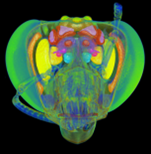 Reconstruction from microscopy.org.
What would be most satisfying is to understand how human brains represent concepts & perform computations. Biological computing is nothing like machine computing. It is not like the binary AND-OR logic gates that run business systems, and it is not like the weighted sum activations in AI. We don't know yet, but perhaps biocomputing might be more like the oscillations dynamics ubiquitous at all scales in nature -- from oscillating molecular reactions, to brain wave oscillations, to oscillating planetary motion. To understand brain dynamics, we need instruments that can probe at the cellular cluster level. That, will get us closer to the bee brain.
Make no mistake, today's AI is built upon concepts from biology -- period. Understanding that biology better will help us vastly improve AI and build wetware computing systems.
At Kyber-X, this is what we do. Meet our team.